
Flooring Worksservice details
service details

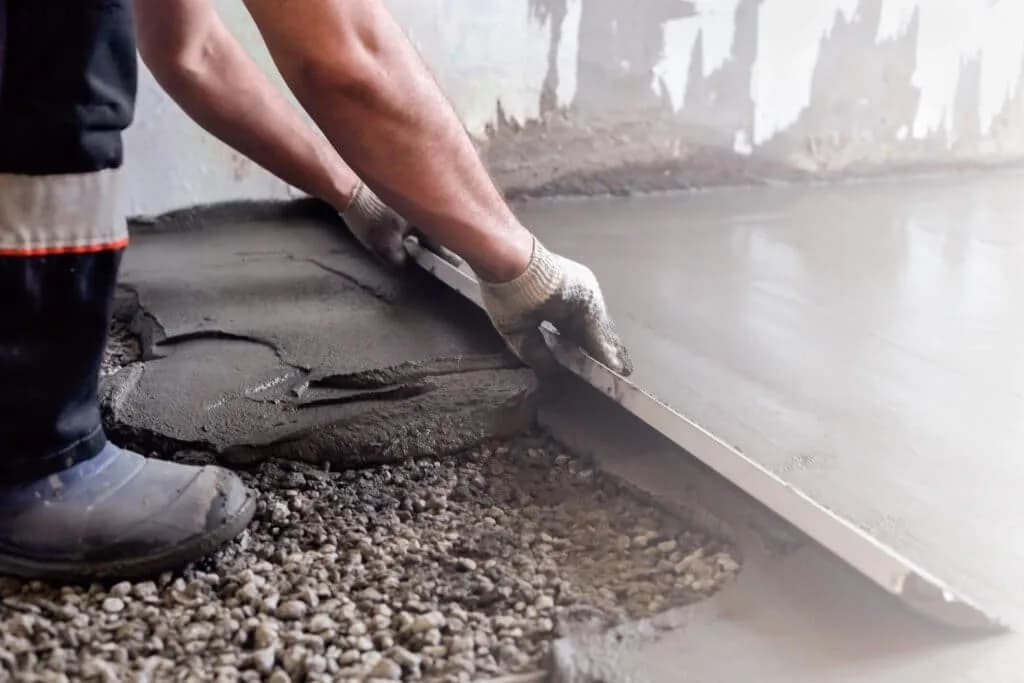
helicopter floors
Helicopter floors are a type of concrete that is leveled using a helicopter to create a smooth, flat surface. United Hardener, a distinctive cement-gray color, is added. Although it can be colored, it is not recommended, as mixing it with oxides reduces its lifespan and weakens its strength and hardness.
What are helicopter floors?
Helicopter floors are one of the best types of flooring, achieved by smoothing and leveling the surface using a special helicopter machine after pouring concrete. These floors are characterized by their smooth and durable surface, making them an ideal choice for factories, warehouses, and home use.
Features of helicopter floors
- Durability: These floors have the ability to withstand heavy loads and pressure.
- Efficiency: Provides high performance both in installation and in ease of maintenance.
- Cost: Its installation cost is reasonable compared to many other types of flooring.
- Maintenance: It requires only limited periodic maintenance and is low cost.
Screed Works Helicopter Flooring Steps
- Soil leveling and compaction: Rapid prepares the soil thoroughly, and if it is weak, a replacement layer is created using the same layers used in asphalt works to ensure a strong foundation for pouring concrete.
- Soil insulation: It is preferable to place a nylon tarpaulin on the soil before pouring to prevent mixing water from seeping in.
- Heavy loads: When there are heavy loads, ordinary concrete with a thickness of 10 cm is poured.
- Casting Methods: It is recommended to pour in strips no more than 4 meters wide and 35 meters long, using metal ties instead of wooden ones to ensure the straightness of the tiles.
- Reinforcement: It is preferable to reinforce the slabs in two layers (top and bottom) to achieve additional strength.
- Tile Bonding: Tiles are bonded using dowels or iron bars to prevent any settlement differences.
- Concrete mix: Pour concrete with a content of no less than 350 kg cement/m³, with the addition of fiberglass fibers, while preventing the use of setting-retarding additives.
- Concrete leveling: The concrete is leveled well with a trowel, then after it has hardened to a level that allows walking on it, the hardener is sprayed at a rate of 3 kg/m².
- Roughing stage: Roughen the surface with a helicopter machine using a roughing tray for three perpendicular faces.
- Smoothing stage: Use a helicopter to smooth the surface on several perpendicular faces until a glassy texture is achieved.
- Tight spaces: Letters and corners are hand finished to ensure a quality finish.
- Joints: The tiles are cut the next day to a depth of 2 cm, so that the area of one tile does not exceed 12 m².
- Filling: Filling the joints with a rubber material approved by a specialized company.
Why choose Rapid for your helicopter floor installation service?
- Specialized expertise: The Rapid team has extensive experience in implementing helicopter floors to the highest quality standards.
- Quality Construction: Using the finest materials such as hardener and fiberglass to ensure a strong, smooth, and long-lasting floor.
- State-of-the-art equipment: Relying on advanced helicopter machines to achieve a perfect finish with a glass-like texture.
- Precision in detail: From soil leveling to joint filling, we pay attention to every step to ensure the tiles are straight and prevent any future subsidence.
- Competitive cost: Providing high-quality service at reasonable prices compared to other types.
- Commitment to deadlines: Rapid is known for its speed and discipline in delivering projects on time.
Other services
helicopter floorsEpoxy floor paintspolyurethane floor paintPolyaspartic flooringindustrial floorsSunday – Thursday | 9:00 AM – 5:00 PM test