blog details
.jpeg&w=3840&q=75)
17
May
Epoxy Primer Price: Complete Costs, Benefits, and Best Uses
Imagine spending thousands on a high-gloss epoxy floor, only to see it bubble and peel months later. This common construction nightmare usually isn't a topcoat failure—it’s a foundation failure caused by concrete's natural porosity and hydrostatic pressure. To guarantee lifetime durability, industrial experts consistently look at the overall epoxy primer price as a crucial, non-negotiable investment in project longevity rather than a corner to be cut. As a pioneering leader in advanced flooring systems, Rapid delivers state-of-the-art solutions engineered to transform vulnerable concrete into indestructible surfaces. Whether you manage a heavy-duty plant or a commercial facility, understanding how to evaluate the standard epoxy primer price is the first step to safeguarding your infrastructure from the ground up.
What is an Epoxy Primer and Why is it Absolutely Critical?
An epoxy primer is a specialized, low-viscosity foundational coating formulated to act as the primary bonding layer between a raw substrate and subsequent floor toppings. Unlike thick decorative topcoats, a high-quality primer possesses a fluid, penetrating chemical structure. This low viscosity allows it to seep deeply into the microscopic pores, capillaries, and voids of the concrete slab.
When evaluating the market, smart contractors don't just look for cheap alternatives; they weigh the initial epoxy primer price against the catastrophic cost of premature floor failure and delamination. Once the primer penetrates the concrete, it cures to form an inseparable cross-linked chemical bond. This creates a perfectly uniform, highly receptive bonding layer that anchors the entire subsequent flooring system, ensuring that your long-term return on investment far outweighs the upfront product cost.
Core Technical Benefits of Utilizing Epoxy Primers
The application of an epoxy primer is far more than a simple preliminary step; it is a technically sophisticated barrier that enhances the entire flooring ecosystem. Here is how it protects your investment:
1. Complete Concrete Pore Sealing
Concrete is inherently porous, acting much like a dense sponge. If you apply a finishing coat directly to raw concrete, the slab will unevenly suck up the liquid resin. A professional priming coat seals these microscopic voids, ensuring a uniform application for the next phases and protecting you from wasting expensive topcoats.
2. Elimination of Pinholes and Outgassing Bubbles
One of the most frequent failures in resinous flooring is "outgassing"—where air and trapped moisture vapor escape upward from the concrete as temperatures change. Without a sealed base, this rising air creates unsightly pinholes and permanent bubbles in your wet topcoat. Spending on a reliable epoxy primer price completely eliminates this risk by locking these gases firmly below the surface.
3. Maximum Interlayer Adhesion
Chemical bonding is superior to simple mechanical adhesion. Epoxy primers provide a chemically reactive surface that fuses perfectly with subsequent self-leveling layers or heavy-duty topcoats. This absolute fusion eliminates the risk of peeling or chipping under heavy vehicular traffic.
4. Structural Fortification of the Substrate
By soaking into the upper zone of the concrete slab, the primer consolidates weak, friable concrete particles. This reinforces the tensile strength of the surface layer, boosting its resistance to heavy impacts, mechanical vibrations, and localized structural stresses.
learn more about : epoxy price in egypt
Primary Applications Across Heavy-Duty Industries
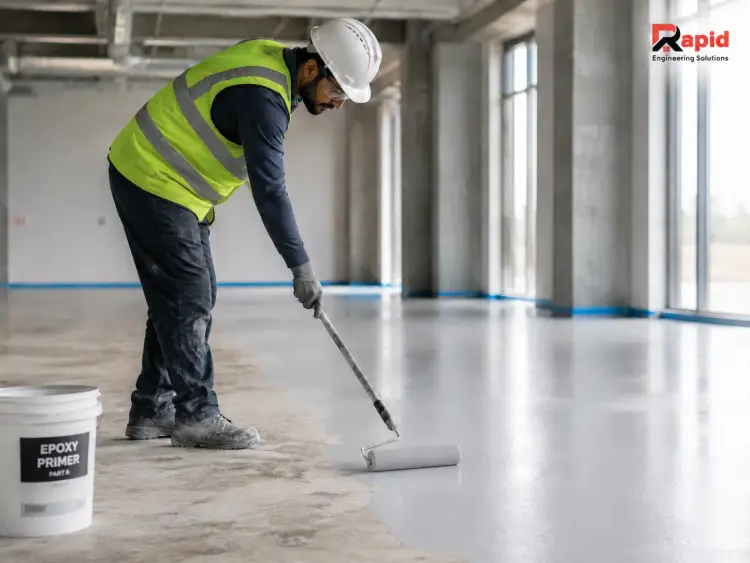
Industrial and commercial settings demand specialized surfaces that can withstand harsh daily realities. Rapid engineers its premium priming systems to satisfy the strict requirements of multiple sectors:
- Industrial Plants and Logistics Warehouses: Heavy machinery, high-capacity forklifts, and constant pallet jack traffic exert massive shear forces on floors. Knowing the dynamic epoxy primer price per square meter allows warehouse managers to accurately estimate large-scale project budgets.
- Automotive Garages and Parking Structures: These zones are constantly exposed to harsh automotive fluids, including engine oils, brake fluids, and fuels. Utilizing an advanced Epoxy Paint and Primer system stops these corrosive chemicals from migrating deep into the concrete and degrading the structural reinforcement steel.
- Water Reservoirs, Tanks, and Swimming Pools: Liquid containment structures face continuous hydrostatic pressures. A dedicated moisture-barrier primer locks out moisture transmission, preventing structural leaks and concrete carbonation.
- Commercial Kitchens, Laboratories, and Workshops: Where sanitization and hygiene are non-negotiable, a perfectly flat, primed, and coated floor eliminates cracks where bacteria, mold, and dangerous pathogens could otherwise breed.
Step-by-Step Professional Application Protocol
Achieving an industrial-grade finish requires rigorous execution and precise engineering standards. The certified application methodology recommended by Rapid includes:
[Mechanical Grinding] - [Dust Extraction] - [Precision Mixing] - [Squeegee/Roller Application] - [Curing & Patching]
Step 1: Mechanical Surface Preparation (Grinding)
The concrete must be structurally sound, clean, and open. Contractors utilize heavy-duty planetary grinding machines equipped with diamond-segmented abrasives to remove "laitance" (a weak, milky layer of cement dust on top) and create an open Concrete Surface Profile (CSP) ideal for primer absorption.
Step 2: Advanced Dust Extraction
Once grinding is complete, all residual dust, micro-particles, and loose debris must be completely extracted using industrial-strength HEPA-filter vacuums. Never use water to wash the floor at this stage. Introducing moisture into the slab before priming is a guaranteed recipe for future coating failure.
Step 3: Precision Component Mixing
Epoxy systems consist of two parts: Base (Component A) and Hardener (Component B). They must be mixed strictly according to the manufacturer’s specified weight or volume ratios. Use a low-speed mechanical drill mixer (300–400 RPM) for 3 minutes to avoid introducing excess air bubbles.
Step 4: Uniform Application and Distribution
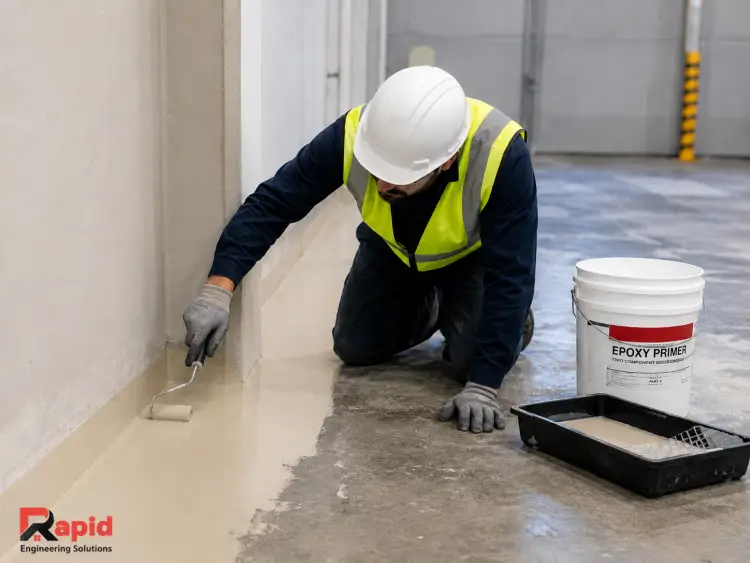
The mixed resin should be immediately poured onto the floor in ribbons and spread using a professional rubber squeegee to force the material into the concrete pores. Follow up immediately with a lint-free, solvent-resistant roller to ensure an even, consistent thickness across the entire floor.
Step 5: Curing, Inspection, and Defect Patching
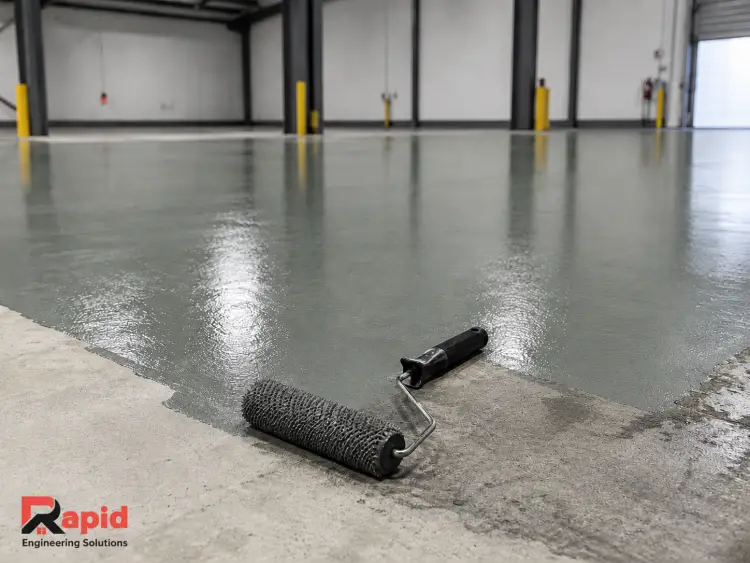
Allow the primer layer to cure for 12 to 24 hours depending on ambient temperature and relative humidity. Dull, matte spots indicate highly porous zones where the concrete completely swallowed the primer. These spots require a localized second application, which might slightly affect your overall estimated epoxy primer price due to concrete conditions.
Pro Engineering Tip: Always measure the internal relative moisture content of the concrete slab before starting. The internal moisture level must not exceed 4% unless you are utilizing a specialized moisture-tolerant primer system.
learn more about : 3d epoxy flooring
Material Consumption Rates and Curing Dynamics
Accurate material estimation prevents costly project delays and avoids material shortages mid-application. While assessing project logistics, calculating the realistic epoxy primer price per square meter is dependent on the following exact technical specifications:
|
Technical Metric |
Standard Industry Average |
Practical Field Notes |
|
Material Consumption Rate |
250 – 400 g/m² |
Deeply affected by concrete roughness and porosity profiles. |
|
Touch Dry Time |
4 – 6 Hours |
Calculated at an ideal temperature range of 25°C to 30°C. |
|
Full Curing Duration |
24 Hours |
The ideal window to wait before applying subsequent coats. |
|
Optimal Application Temperature |
10°C – 35°C |
Avoid application if environmental humidity climbs past 80%. |
|
Pot Life (Working Time) |
30 – 45 Minutes |
Mix only what can be spread immediately to avoid premature gelation. |
Critical Factors Influencing Consumption:
- Concrete Age and Density: Old, weathered, or unsealed concrete slabs absorb liquid rapidly, increasing material consumption and directly impacting your projected epoxy primer price.
- Preparation Method: Shot-blasting or heavy diamond grinding increases the overall surface area by creating micro-ridges, which optimization requires slightly more volume to achieve full saturation.
- Application Machinery: Utilizing a high-quality rubber squeegee ensures the material is pressed tightly into the floor profile, maximizing coverage efficiency compared to relying solely on thick-pile rollers.
Market Overview: Selecting the Right System in 2026
The industrial coatings market offers several solutions tailored to varying performance demands and budgets. When researching options for smaller maintenance tasks or patch repairs, buyers often look closely at variables like the epoxy primer price 1 liter container options, or bulk drums for megaprojects. Here are the leading systems dominating the market today:
Kimapoxy 101
- A widely recognized, traditional standard within the regional market.
- Provides dependable penetration for standard structural projects.
- Functions as an economical option for vast commercial developments where keeping a lower epoxy primer price is a priority.
Sikafloor 161
- An international benchmark choice favored by structural engineers for mega-projects.
- Exhibits extremely low viscosity, meaning it penetrates deep into dense concrete matrices.
- Offers high performance, though it comes with a premium market price.
Rapid Solvent-Free Epoxy Primer
- An advanced, 100% solids, zero-VOC formulation designed by Rapid for modern eco-conscious standards.
- Completely odor-free, making it ideal for occupied facilities, pharmaceutical labs, hospitals, and food processing plants.
- Engineered specifically to balance high-end performance with a highly competitive and justified epoxy primer price.
Learn more about the product Epoxy Coating Materials offered on our website
Expanding Horizons: Can Epoxy Primers Be Used on Other Substrates?
While concrete remains the primary surface for industrial applications, advanced modern polymers have expanded into versatile home and manufacturing uses. While looking up the total commercial epoxy primer price, many craftspeople and specialty builders ask whether these high-performance materials can adapt to alternative surfaces like timber.
For instance, high-end furniture makers and architectural designers often seek out the Best epoxy primer for wood to seal highly porous lumber or live-edge slabs before casting thick artistic river tables or protective clear coats. Priming wood stabilizes the organic fibers, seals natural knots, and prevents the wood from releasing trapped air into the clear casting, which would otherwise ruin the crystal-clear aesthetic finish.
Conclusion: Protect Your Investment with Rapid
Cutting corners by eliminating the priming step is an expensive gamble that always results in floor failure, costly down-time, and extensive re-installation expenses. Securing a reliable epoxy primer price up front ensures peace of mind, knowing your facility's foundation is chemically fortified against the elements. Ultimately, the long-term cost of flooring failures far outweighs the initial investment.
As a dedicated industrial manufacturing partner, Rapid doesn't just sell raw chemical materials; we provide comprehensive turnkey engineering support. From initial substrate moisture inspections and custom formulation selection to on-site technical supervision during application, our team ensures your commercial or industrial flooring project stands the test of time at a reasonable epoxy primer price.
Frequently Asked Questions (FAQ)
Can I apply an epoxy topcoat directly to concrete without a primer?
While technically possible, it is highly discouraged by structural engineers. Skipping the primer typically results in uneven absorption, severe outgassing bubbles, pinholes, and premature delamination or peeling when subjected to heavy daily foot or vehicular traffic.
What is the core difference between an epoxy primer and a polyurethane primer?
Epoxy primers excel in structural bonding strength, concrete penetration, and exceptional resistance to heavy mechanical loads and chemical spills, making them perfect for internal concrete slabs. Polyurethane primers offer significantly higher elastic flexibility and UV resistance, making them better suited for outdoor surfaces.
How should I treat high moisture levels in a concrete floor before priming?
If your concrete slab exhibits an internal relative humidity above 4%, you must allow the floor additional curing time, locate and fix any external water leaks, or apply a specialized moisture-barrier epoxy primer engineered by Rapid to withstand high hydrostatic pressure without losing adhesion.
.jpeg&w=3840&q=75)